
The NICE code computes tokamak plasma equilibria. Its equilibrium reconstruction functionalities are routinely used at CEA on the WEST tokamak, and at UKAEA by the STEP team since 2023. NICE is a code that fits with the required standards of the IMAS platform. This code allows for industrial applications. IMAS is a platform adopted from the fusion community in order to collect and operate different codes (plasma equilibrium, transport, and many others) together and which is/will be used for all physics modeling and analysis in tokamaks, particularly ITER. It uses a modular approach that builds around a standardized data representation that can describe both experimental and simulation data for any tokamak.
Research
Computational Fluid Dynamics
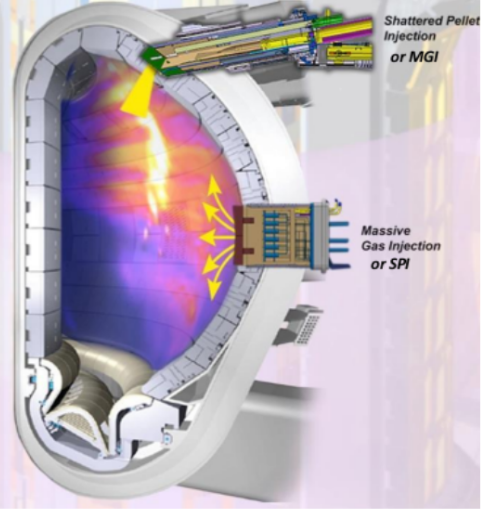
The modeling of nuclear fusion plasmas in tokamaks relies heavily on magnetohydrodynamics, which treats the plasma as an electrically conducting fluid responding to magnetic fields. This framework has been crucial in predicting plasma behavior in tokamaks, particularly for understanding macroscopic instabilities such as kink modes, tearing modes, and edge-localized modes (ELMs). Current challenges in controlling these instabilities include the difficulty in predicting their onset conditions in realistic operational scenarios, or limitations in real-time response systems for instability mitigation. These challenges are central to international fusion projects like ITER, where maintaining plasma stability remains a critical hurdle to achieving sustainable fusion energy.
Modeling of turbulent flows
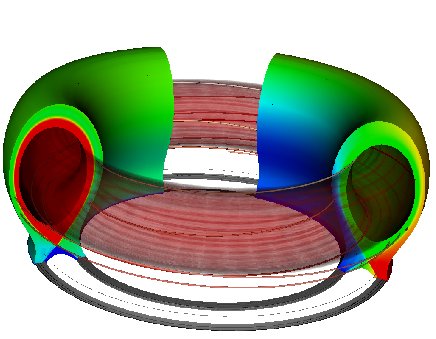
The modeling of nuclear fusion plasmas in tokamaks relies heavily on magnetohydrodynamics (MHD), which treats the plasma as a conductive fluid influenced by magnetic fields. This framework has been crucial in predicting plasma behavior, particularly for understanding macroscopic instabilities such as kink modes, tearing modes, and edge-localized modes (ELMs). Current challenges in controlling these instabilities include the difficulty in predicting their onset conditions in realistic operational scenarios, or limitations in real-time response systems for instability mitigation. These challenges are central to international fusion projects like ITER, where maintaining plasma stability remains a critical hurdle to achieving sustainable fusion energy.
Magnetohydrodynamics
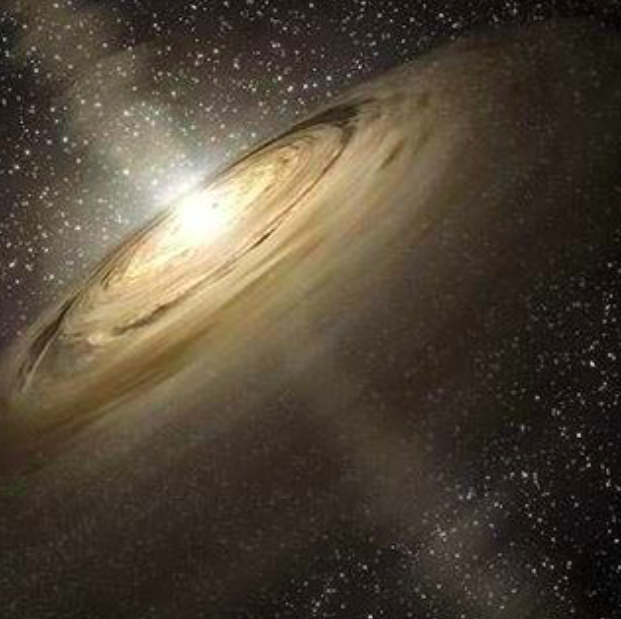
Magnetohydrodynamics (MHD) couples Maxwell’s equations of electromagnetism with hydrodynamics to describe the macroscopic behavior of conducting fluids such as plasmas. It plays a crucial role in astrophysics, planetary magnetism, engineering and controlled nuclear fusion. The study of fluid dynamics is of key relevance for the simulation of environmental systems, including atmospheric and oceanic flows.
For more details on the research activities and projects of the team, please refer to the
personal webpages and to the team annual report. Do not hesitate to
contact us for scientific collaborations and/or training periods within the team.
Team Members

Stéphane Abide
Full professor at UniCA
Computational fluid dynamics. High Performance Computing.
Email: stephane.abide [at] univ-cotedazur.fr
Personal Website →
Didier Auroux
Full professor at UniCA
Inverse problems, Data assimilation, Parameters identification.
Email: auroux [at] unice.fr
Personal Website →
Jacques Blum
Full professor at UniCA (Emeritus)
The creator of the team in 2012. Data assimilation, Optimisation, Inverse problems.
Email: jacques.blum [at] univ-cotedazur.fr
Personal Website →
Cédric Boulbe
Assistant professor at UniCA
Numerical methods and simulation, Tokamak plasma equilibrium.
Email: cedric.boulbe [at] univ-cotedazur.fr
Personal Website →
Blaise Faugeras
Research engineer HC at CNRS
Numerical methods and simulation, Tokamak plasma equilibrium.
Email: blaise.faugeras [at] inria.fr
Personal Website →
Hervé Guillard
Research director at INRIA (Emeritus)
Numerical methods for plasmas, Multiphase flows, Shallow waters.
Email: herve.guillard [at] inria.fr
Personal Website →
Florence Marcotte
Research associate at INRIA
Magnetohydrodynamics, Nonlinear instabilities, Astrophysical fluid dynamics.
Email: florence.marcotte [at] inria.fr
Personal Website →
Boniface N'Konga
Full professor at UniCA
Plasma modeling and simulation, High Performance Computing.
Email: boniface.nkonga [at] univ-cotedazur.fr
Personal Website →
Francesca Rapetti - Head of the CASTOR project
Full professor at UniCA
Maxwell equations and Galilean electromagnetism, High-order Finite Elements, Whitney differential forms and discrete exterior calculus, Scientific Computing.
Email: francesca.rapetti [at] univ-cotedazur.fr
Personal Website →
Afeintou Sangam
Assistant professor at UniCA
Modeling, Numerical Analysis, Scientific Computing, Plasma Physics.
Email: afeintou.sangam [at] univ-cotedazur.fr
Personal Website →External Group Collaborator

Didier Clamond
Full professor at UniCA
Gravity Waves and Nonlinear Waves, Fluid and Continuum Mechanics, Mathematical and Numerical Modelling
Email: didier.clamond [at] univ-cotedazur.fr
Personal Website →
Yannick Ponty
Research director at CNRS
Magnetohydrodynamics, Fluid and dynamo instabilities, High Performance Computing.
Email: yannick.ponty [at] oca.eu
Personal Website →Team Assistant at Inria

Nathalie Nordmann
Email: nathalie.nordmann [at] inria.fr
Ph.D. students

Anais Antonini
Email: anais.antonini [at] inria.fr

Raphaël Granger
Email: raphael.granger [at] inria.fr
Muhammad Muhammad Lawal
Email: muhammaddmlawall [at] gmail.com

Clément Mariot
Email: clement.mariot [at] inria.fr

Aleksandar Stojcheski
Email: stojcheskialeksandar [at] gmail.com
Postdocs
Shijun Chu
Email: shijun.chu [at] inria.fr
Mustapha Bahari
Email: mustapha.bahari [at] inria.fr
Software
NICE (Newton direct and Inverse Computation for Equilibrium)
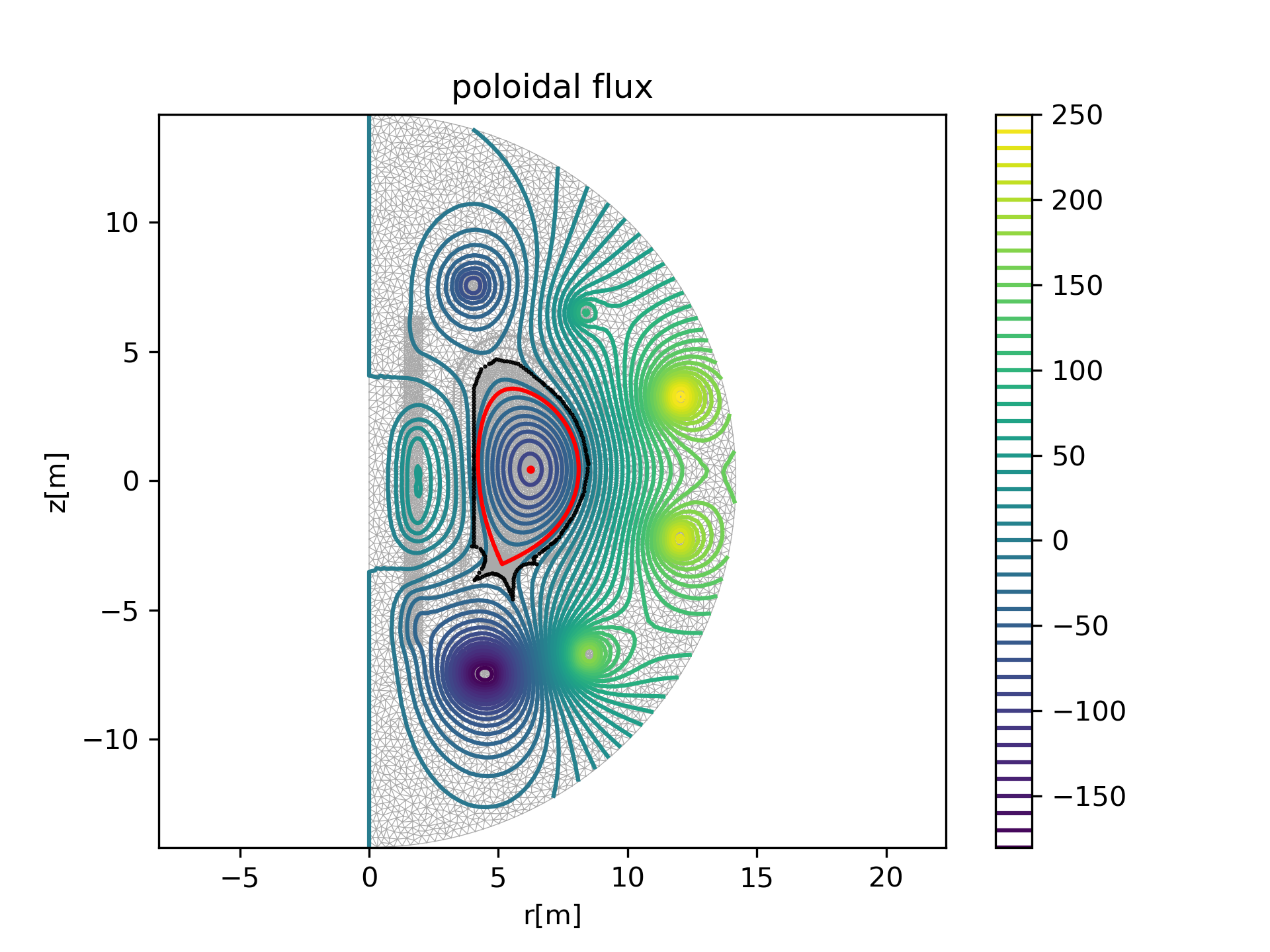
NICE
contains dedicated solvers for several problems of free-boundary plasma
equilibrium:
Real-time plasma free-boundary only reconstruction and magnetic measurements interpolation.
The method used for this computation mode is based on the
use of toroidal harmonics and on a modeling of the poloidal field coils
and divertor coils to perform the 2D interpolation and extrapolation of
discrete magnetic measurements in a tokamak and the identification of
the plasma boundary. The method is generic and can be used to provide
the Cauchy boundary conditions needed as input by a fixed domain
equilibrium reconstruction computation. It can also be used to
extrapolate the magnetic measurements to compute the plasma boundary
itself.
Feature point two
Full free-boundary equilibrium reconstruction from magnetic
measurements and possibly internal measurements (interferometry,
classical linear approximation polarimetry or Stokes model polarimetry,
Motional Stark Effect, and pressure). In this mode, the problem solved
consists of the identification of the plasma current density, a
non-linear source in the 2D Grad-Shafranov equation, which governs the
axisymmetric equilibrium of plasma in a Tokamak.
Feature point three Direct and inverse, static and
quasi-static evolution free-boundary equilibrium computations. In a
Tokamak, at the slow resistive diffusion time scale, the magnetic
configuration in the plasma can be described by the
MHD equilibrium equations are inside the plasma, and Maxwell
equations are outside. Moreover, the magnetic field is often supposed
not to depend on the azimuthal angle. Under this assumption of
axisymmetric configuration, the equilibrium in the whole space reduces
to solving a 2D problem in which the magnetic field in the plasma is
described by the well-known Grad Shafranov equation. The unknown of this
problem is the poloïdal magnetic flux.
In this computation mode, the direct problem consists of computing
the magnetic configuration and the plasma boundary, given a plasma
current density profile and the total current in each poloïdal field
coil. The aim of the inverse problem is to find currents in the PF coils
that best fit a given plasma shape.
NICE gathers in a single finite-element framework different equilibrium
computation modes and numerical methods from the former VACTH, EQUINOX
and CEDRES++ codes developed within Castor project.
NICE project leaders: B.Faugeras, C. Boulbe.
The JOREK non-linear MHD Code

Part of the Castor team participates actively to the non-linear extended MHD code JOREK resolves realistic toroidal tokamak X-point geometries with a G1 continuous flux-surface aligned grid including main plasma, scrape-off layer and divertor region.
Contact: H. Guillard, B. N'Konga.
Open positions
PhD Position in Turbulent Flows
We are seeking a highly motivated PhD candidate to join our research group. The project focuses on experimental investigation of turbulent flows using advanced measurement techniques.
Requirements:
- Master's degree in Mechanical Engineering, Physics, or related field
- Strong background in fluid mechanics
- Experience with experimental techniques
Contact: castor.permanents [at] inria.fr
Postdoctoral Position in CFD
A postdoctoral position is available in the area of computational fluid dynamics, focusing on developing new numerical methods for complex flow simulations.
Requirements:
- PhD in Mechanical Engineering, Applied Mathematics, or related field
- Strong programming skills
- Experience with CFD software
Contact: castor.permanents [at] inria.fr